Executive Assistant vs Director of Operations (and Where a Virtual Assistant Fits): Which Remote Hire Do You Need?
GRIT Staffing · · 5 min read
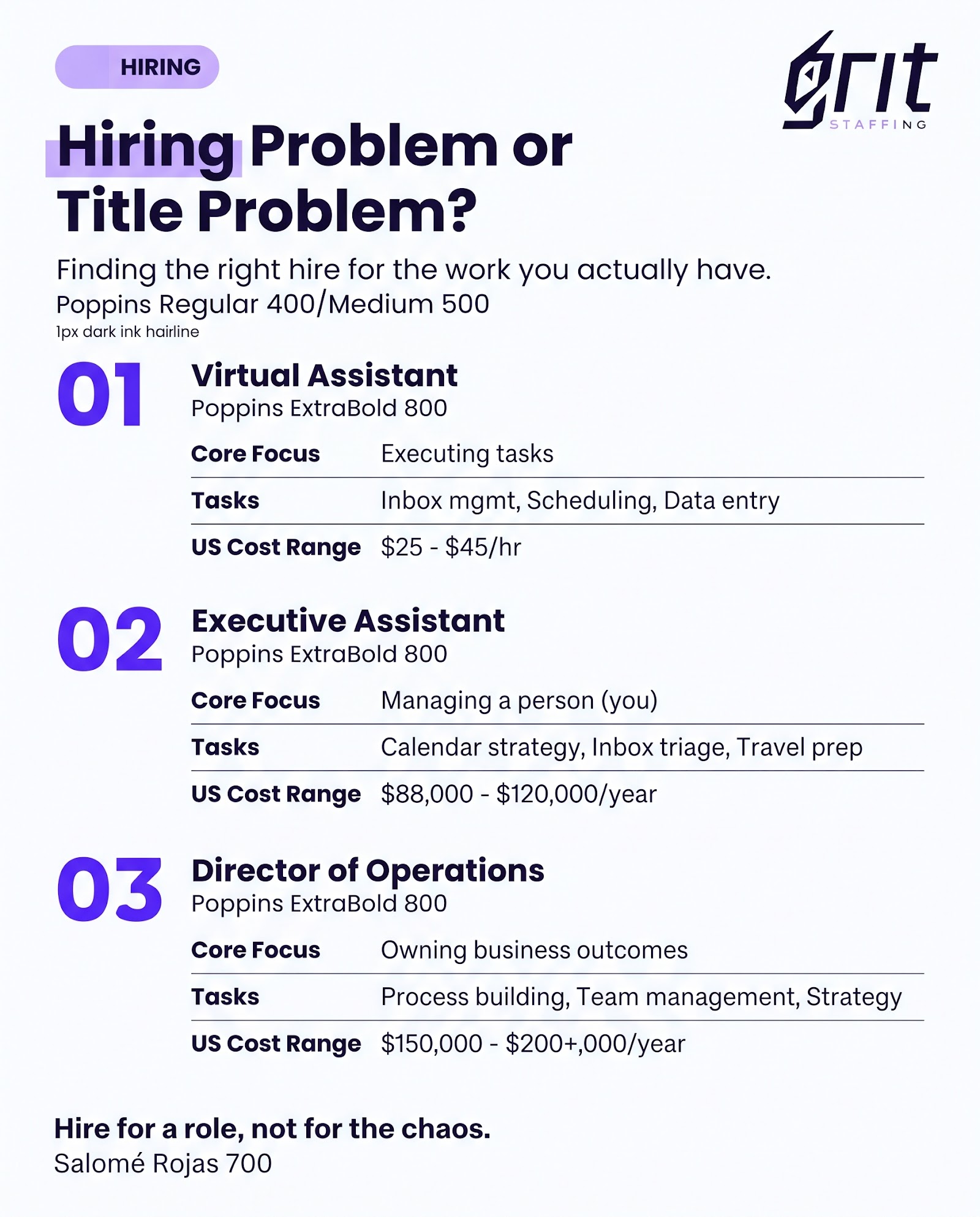
Most business owners who tell us they have a hiring problem really have a title problem. They ask about executive assistant vs director of operations, or whether a virtual assistant would be enough, when the real question is what work needs doing.
It usually goes like this. You know you need help, so you post a job called "Virtual Assistant." Quietly, you're hoping whoever takes it will also cover the work of an Executive Assistant, and maybe some of what an operations lead would do.
A few months later you're frustrated that someone hired to execute tasks isn't showing six-figure judgment. Paying more won't fix that. Hiring for the work you actually have will.
The three roles
A Virtual Assistant executes. Inbox, scheduling, data entry, research, basic customer support. Give a good VA clear instructions and the work comes back fast and done right.
What you shouldn't hand them is the job of deciding what matters most. When that goes badly, the VA isn't lacking skill. You've asked them to do a different job.
An Executive Assistant manages a person. Usually you. They handle calendar strategy, inbox triage, travel and meeting prep, and they chase down the things you said you'd do and didn't.
A good EA makes decisions inside the boundaries you've set, and has a good sense of where those boundaries are.
A Director of Operations owns outcomes. They hire and manage the team, build and repair processes, report on the numbers that matter, and make the calls you don't have time for.
This is a leadership hire, and you should evaluate it like one. You shouldn't need to check their work day to day, only the results.
You can see how we staff each of these on our roles page.
Executive assistant vs director of operations: the real difference
These two get confused the most, because both sit close to the owner and both take things off your plate. The difference is what they take.
An Executive Assistant protects your time. Their work revolves around your calendar, your inbox and your commitments. If you disappeared for a month, most of their job would pause with you.
A Director of Operations protects the business. Their work revolves around the team, the processes and the numbers. If you disappeared for a month, their job would get bigger.
A quick way to tell which one you need is to look at where things get stuck. If they get stuck in your inbox or on your calendar, you need an EA. If they get stuck because nobody but you can make a decision or manage the team, you need a Director of Operations.
Another test is who this person would manage. An EA manages your schedule and the people trying to get onto it. A Director of Operations manages employees and contractors, and answers for what they deliver.
What each one costs in the US
Look at these before you write the job post. They're the reason "just hire an assistant" turns out to be three separate decisions.
Executive Assistant: median $88,727 a year (about $43 an hour), typically $71K to $109K. Source: Salary.com, October 2026.
Director of Operations: median $204,674 a year (about $98 an hour), typically $173K to $242K. Source: Salary.com, October 2026.
Virtual Assistant, US-based: $25 to $45 an hour. Offshore VAs doing comparable work commonly charge $4 to $20 an hour.
The US numbers aren't wrong. But the gap between the roles is big, and that makes a mismatch expensive in both directions.
Paying Director of Operations money for VA work is a bad deal at any price. So is paying VA rates and expecting a Director of Operations to show up.
GRIT fills all three roles with talent based in Colombia, at a fraction of the figures above. Any staffing company can say that, so don't take our word for it.
In the interview, ask how the person was vetted for the role, and don't stop at the rate. Our vetting process is public if you want to compare.
Signs you need to move up a level
Every single day, you're the one deciding what your assistant works on.
Things get done but nothing gets better. No process improves and no metric moves.
You've hired more than one VA for the "same" role and you keep landing back here.
The task list now includes "manage the other contractors." That's an operations job, whatever the title says.
Signs you're paying for more than you need
The role is 80% calendar and inbox, and you hired for strategic ownership.
You're paying for judgment on decisions that already have a clear, repeatable answer.
Nobody reports to this person, and nothing they do moves a company-level number.
If money is tight, hire in this order
Virtual Assistant first. Hand off anything that eats your calendar and doesn't need your judgment. This is usually the hire with the most leverage, because it's the cheapest way to buy your own hours back.
Executive Assistant next. Make this hire once the bottleneck is specifically your calendar and inbox, and no longer your task list in general.
Director of Operations last. By this point the business has outgrown what you can personally oversee, and decisions are waiting on you that someone else could own.
Before you write the job post
Whichever role you land on, write down three things first.
Start with the five tasks this person will spend most of their week on. If all five are things you could explain in a short video, you're describing a VA.
Then list the decisions they can make without asking you. A short list with clear limits describes an EA. A long list that includes hiring, spending or changing how the team works describes a Director of Operations.
Last, decide how you'll know in 90 days that the hire worked. "My inbox is under control" and "the team hits its numbers without me in every meeting" are very different goals, and they belong to different roles.
If your answers point to two roles at once, that's normal. Hire for the one that covers most of the week, and be honest in the job post about the rest.
So which one are you?
The executive assistant vs director of operations question gets easier once you stop looking at titles. Ask what's costing you the most right now: time, follow-through, or oversight.
Each answer points to a different hire, with a different price and a different job description.
If you can't tell which one you are, book a discovery call. Figuring that out is most of what the first call is for. You can also read more about GRIT first.